
How Ecommerce Brands Collect Customer Feedback Without Survey Fatigue

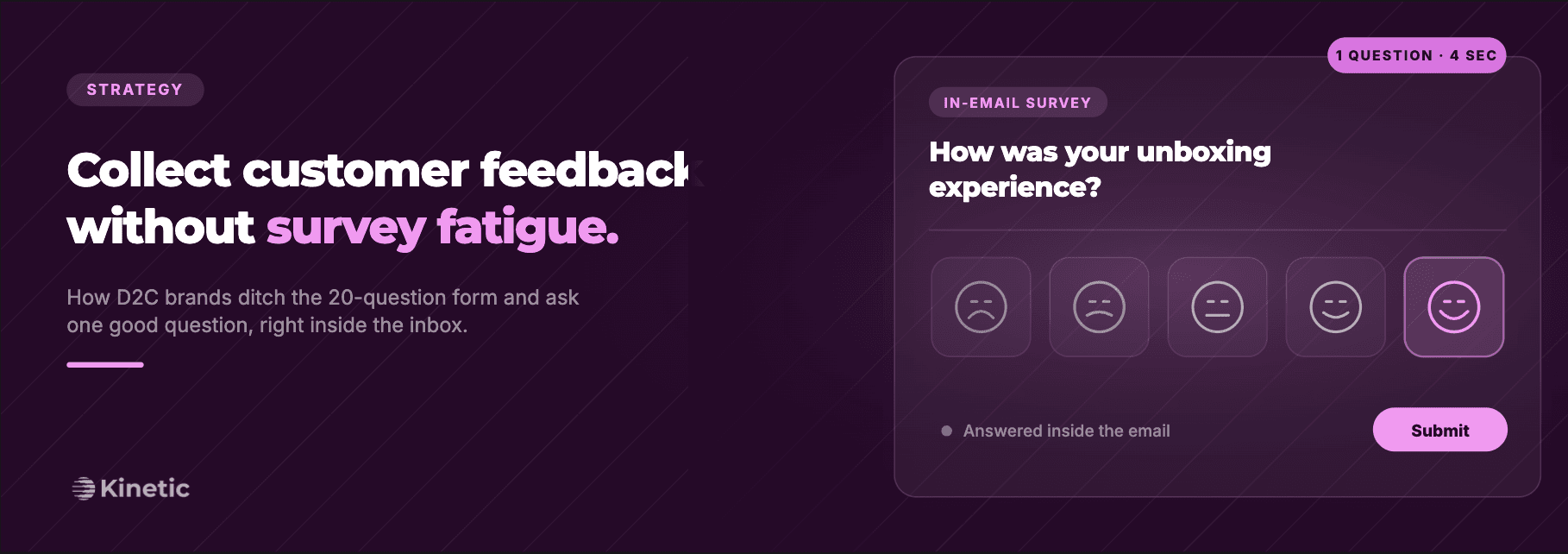
We have all been there. You open an email from a brand you actually like, and they're asking for "just 5 minutes" of your time to help them improve. You click through, see a progress bar at 0% after three questions, and immediately bail.
That my friends is what we call survey fatigue, and it is killing your data strategy.
In an era where customer acquisition costs (CAC) have spiked by 40-60% since 2023, you cannot afford to guess what your customers want anymore. But you also cannot afford to annoy them with clunky, 20-question forms that feel like a homework assignment. The answer isn't "stop asking for feedback” though. It’s to stop making it so hard to give.
Today, I am unpacking how the best D2C brands are shifting from "active surveying" to "passive listening" and micro-feedback loops that live where your customers already are: the inbox.
Inside this page
Share this
Summarize with AI
Key Takeaways
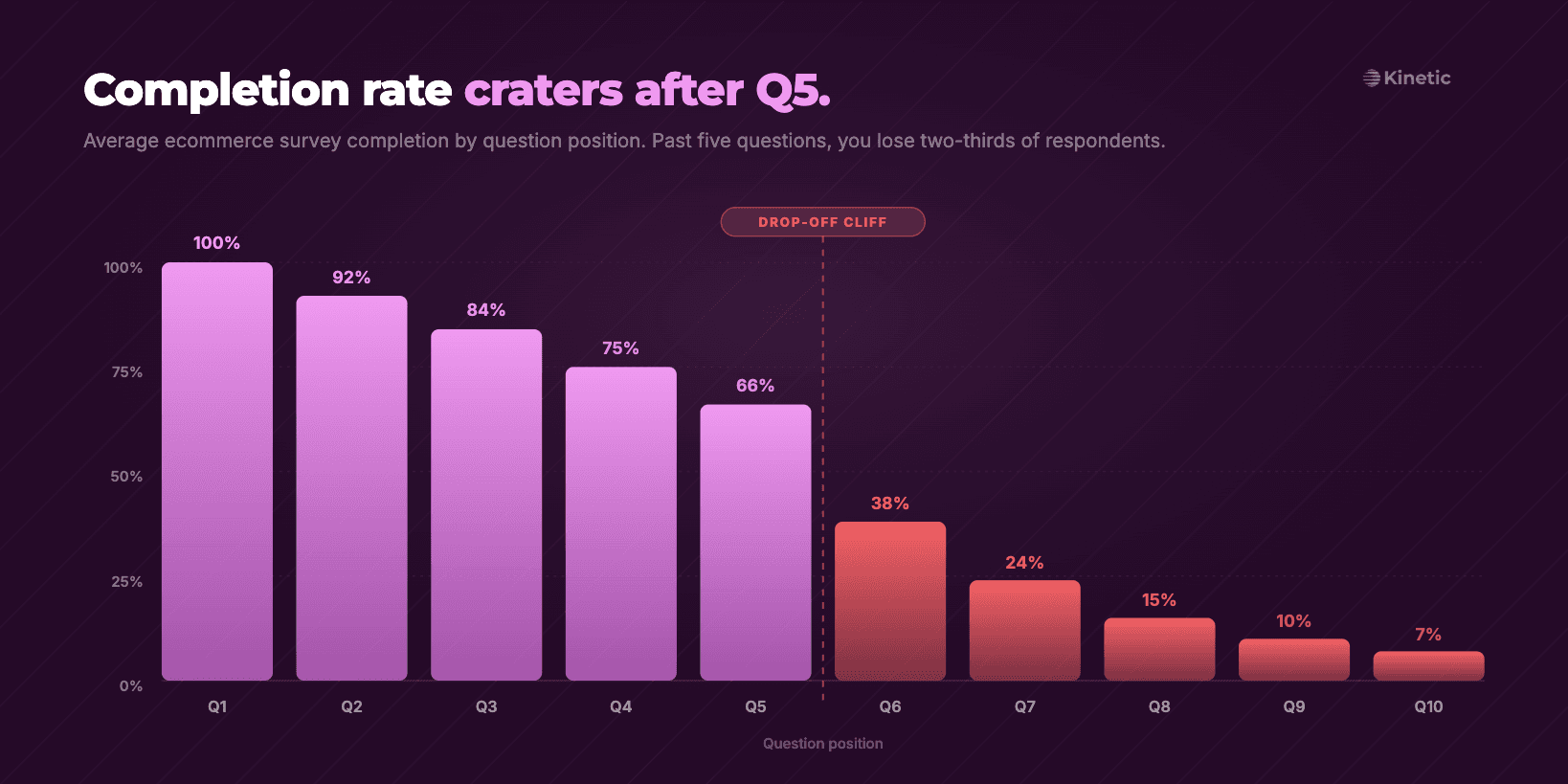
Keep it under 5: 74% of customers won't finish a survey longer than five questions.
Listen passively first: Analyze support tickets and behavioral data before sending active surveys to reduce "silent feedback" gaps.
Micro-loops win: Shift from long annual surveys to frequent, one-question "micro-surveys" embedded in the customer journey.
Stay in the inbox: In-email interactive forms can triple response rates by removing the landing page redirect.
Incentivize properly: A simple 10% discount can boost survey response rates from 12% to 37%.
What is survey fatigue in ecommerce?
Survey fatigue is the mental exhaustion customers feel when they are bombarded with too many feedback requests or surveys that are too long to finish. In ecommerce, this usually leads to "silent churn"where customers stop buying without ever telling you why.
Don't just take my word for it. The data is pretty brutal. A 2017 study by Customer Thermometer found that 70% of people have abandoned a survey before finishing it because it was too long. Even worse? Only 9% of people actually take the time to answer long surveys thoughtfully. The rest are just clicking "next" to get to the discount code, which means your data is basically noise.
How to track customer feedback effectively in 2026
In 2026, the brands winning the retention game aren't just looking at one-off surveys. They are tracking continuous feedback loops. You should be aiming for a CSAT (Customer Satisfaction Score) of 80% or higher and an NPS (Net Promoter Score) of +45 or more.
A 5% increase in customer retention can boost profits by 25% to 95%, according to Bain & Company. Tracking feedback isn't just about feeling good; it's about identifying the 32% of customers who will walk away after just one bad experience. You need to catch those bad experiences before they turn into churn statistics.
5 low-friction ways to collect feedback
When you do need to ask, keep it micro. Here are the five best ways to get answers without the fatigue:
Post-purchase micro-surveys: Ask one question on the "Thank You" page. "How did you hear about us?"
In-email interactive forms: Let them answer right in the inbox (we'll get to this in a second).
"Was this helpful?" widgets: Standard on FAQ pages, but try them on product descriptions too.
SMS check-ins: Only for your VIPs. Keep it under 160 characters.
The 2-Question NPS: "How likely are you to recommend us?" + "What is the #1 reason for your score?" That's it.
Why in-email forms solve the fatigue problem
Every time you ask a customer to click a link in an email to "go to a survey," you are creating a leak in your funnel. You're asking them to leave their current context, wait for a landing page to load, and then navigate a new UI. Most people do this equation in their head and don't even bother clicking.
That's the whole reason response rates sit at 1-2% for most brands. It's not that your customers don't have opinions. They most certainly do. They just aren't willing to trade three taps and a page load to share them with you, especially on a phone, on the couch, halfway through dinner.
In-email forms close that gap. The questions live inside the email itself, so a customer can tap an answer the moment they read it and move on. No redirect. No landing page. Brands that switch over typically see response rates jump to somewhere between 20% and 40%, depending on the questions and the audience.
If you want to try it on your own list, Kinetic is built for exactly this. Not only that, but the same email forms work on your Shopify store, so you can use them across all your customer touchpoints to maximize the chances of getting a response.
How to design a KYC form people actually finish
If you're building a "Know Your Customer" (KYC) or profiling form, remember the "Rule of 5." Research from GatherUp shows that 74% of customers are only willing to answer five questions or less.
If you absolutely need more than five, you have to earn it. Offering a 10% discount can increase response rates from 12% to 37%, according to First Pier. But the real secret? Progressive profiling. Don't ask all 15 questions at once. Ask two questions in the welcome email, two in the post-purchase flow, and two in a "how's it going?" check-in.
Conclusion
The goal of feedback isn't to fill a spreadsheet with data points. It is to understand the human on the other side of the screen. In 2026, that means being respectful of their time.
Shift your strategy from "how can I get them to take this survey" to "how can I make it impossible for them not to give me feedback." Use your passive data first, keep your active requests under five questions, and whenever possible, let them answer without leaving their inbox.
And there you have it. The circle of feedback laid out before your very eyes. Hopefully, this helps you build an ecommerce brand that listens as well as it sells.
FAQs
What is the best way to ask for customer feedback?
The best way is to ask in the moment of experience using micro-surveys. Instead of a long email days later, ask one question on the order confirmation page or embed an interactive form directly in an email. This captures feedback while the experience is fresh.
How do you overcome survey fatigue?
You overcome survey fatigue by reducing the frequency and length of your requests. Focus on "passive" feedback (like analyzing support tickets) and use "progressive profiling" to ask only 1-2 questions at a time across multiple touchpoints.
What are the 3 main types of customer feedback?
The three main types are Direct feedback (surveys, reviews), Indirect feedback (social media mentions, support tickets), and Inferred feedback (behavioral data like website click patterns and purchase history).