
Playbook: Skincare
How it works
Batch-and-blast is dying. Smart skincare brands are leveraging zero-party data.
THE OLD WAY
Link to external quiz from email
DEAD
80% drop off before the first question loads.
Post-purchase survey via web page
HIGH FRICTION
New tab, new page, customers hate it.
Segments from purchase history only
BLIND
You know what they bought, not that their skin needs.
Same email to entire list
LOW ROI
Oily skin gets the same email as dry skin. Nobody converts.
With kinetic
Quiz lives inside the email
3X MORE RESPONSES
Customer answers without leaving inbox. No drop-off.
One-tap check-ins
ZERO FRICTION
"Are you noticing any changes?" syncs to Klaviyo instantly.
Real customer understanding
YOUR DATA
Concerns, preferences, type. All zero-party, all in Klaviyo.
Right product, right person, right time
HIGHER ROI
Acne-prone skin gets salicylic acid. Aging skin gets retinol.
Ways to use kinetic
01
Product Quiz
Multiple pages. Ends with a personalized product recommendation. Ideal for building a complete skin profile on day one.
Welcome
>25% completion and the base for zero-party data strategies
02
Single-Page Form
One question. One tap. Zero friction. Best for progress check-ins, satisfaction tracking, and pulse surveys. Shows your subscribers how easy responding is.
Post-Purchase
Seasonal
Highest response rate of any form type
03
Multi-Page Form
Multiple questions without a product recommendation. Targets re-profiling customers whose skin has changed: new concerns, new sensitivities, seasonal shifts.
Winback
Post-Purchase
Quarterly
Captures 3-5 (or more) data points per interaction
04
Coupon-Gating Questions
1-2 questions unlocking a discount code. Captures skin type and primary concern in exchange for the discount you were already giving away.
Welcome
Birthday
Winback
Higher completion as the discount motivates the answer
What to build
Now let's walk through how to use Kinetic at every stage of your customer's journey.
WELCOME
Know their skin before the first product ships.
Most skincare brands send a welcome email with a discount code and nothing else. Your first email is the moment a customer is most willing to tell you about themselves.
Four questions fix that:
What's your skin type? (Single select: Oily / Dry / Combination / Normal / Sensitive)
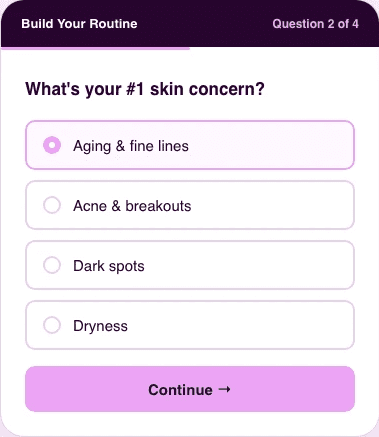
What's your #1 skin concern? (Single select: Acne / Aging / Dark spots / Dryness / Redness)
What does your routine look like today? (Single select: Nothing yet / Just cleanser & moisturizer / Full routine with actives)
Any ingredients you avoid? (Multi-select: Fragrance / Essential oils / Retinol / Sulfates / Alcohol / None of these)
Why the sensitivity question matters more than age: Age is a proxy. Sensitivity is the real signal and the wrong recommendation here doesn't just fail to convert, it causes a reaction. Sync this answer to a Klaviyo property and use it such that every recommendation email you send automatically excludes products containing flagged ingredients. No more pushing fragranced toner at the customer who told you fragrance breaks her out.
Here's where the real value starts.
The quiz gives you a customer profile. What matters is what you do with it.
Email 2 (day 2): "Based on your dry skin and aging concern, here's your 3-step starter routine."
Three specific products picked for her exact skin profile. Not a category page. Not "shop moisturizers." Three products.
Email 3 (day 4): "Why retinol works for aging on dry skin — and how to start without irritation."
Ingredient education tailored to her concern. An "acne" customer gets a completely different email about salicylic acid instead.
Email 4 (day 7): "Meet three customers with dry, aging skin who love their routine."
Social proof filtered to match: Reviews from people with the same skin profile. Not random testimonials.
The lighter version: Gate your welcome discount.
A full quiz isn't always the right move for day one. If you already offer a welcome discount, stop giving it away for nothing. Put 2-3 questions in front of it.
"Answer three quick questions, unlock your 10% off."
What's your skin type? (Oily / Dry / Combination / Sensitive)
What's your #1 skin concern? (Acne / Aging / Dark spots / Dryness)
What does your routine look like today? (Nothing yet / Cleanser & moisturizer / Full routine)
Three questions give you 80% of the personalization value of the full quiz. The "oily + acne + nothing yet" customer sees a starter kit. The "dry + aging + full routine" customer sees a single high-end serum to slot in. The routine-level question prevents you from recommending products she already owns — the fastest way to look out of touch.
Even lighter: One question to segment your entire list.
Drop this into any mail of your welcome flow:
One tap. The answer flows to Klaviyo. Now your next product launch email shows anti-aging serums to the aging segment and oil-free moisturizers to the acne segment. One question. Four personalized streams.
POST-PURCHASE
Catch the dropout before it happens.
Skincare products take 4-6 weeks to show results. Customers decide whether to reorder in 2 weeks. That gap is where you lose them. By the time she stops reordering, it's too late to change her mind.
Three single-page check-ins, spaced across the bottle, change that.
Add single-page forms at 3 points:
Day 7: "How's your skin feeling?"
Day 14: "Are you breaking out more than usual?"
Day 30+: "Any changes you can see?"
Why the purging check matters more than any other
Active ingredients — retinol, salicylic acid, AHAs — cause an initial breakout phase that looks identical to a bad reaction. Customers panic, return the product, and tell two friends it "broke them out." The truth is the product was working: the purge means dead skin and clogged pores are surfacing on schedule.
One question at week 2 catches this. The "Yes, more than expected" branch sends a single email: "This is purging — not a reaction. Here's what to expect over the next 4 weeks, and the exact day your skin should clear." That email saves the customer, the product, and the review.
Why the replenishment check beats scheduled reorder reminders
Most brands send a reorder email on day 30 or day 45 because that's when their average customer runs out. But the average is a lie: power-users finish a serum in 6 weeks, light-users in 12. A scheduled reminder sent to the light-user feels pushy and gets ignored. Asking the question puts the trigger in her hands. The "almost gone" answer is pure intent and gets a one-click reorder email within the hour.
What happens next — based on their answers:
"Loving it" →
Cross-sell at the highest-intent moment you'll ever get. "Since [product] is working for your skin type, add [complementary product] to your routine."
"Yes — breaking out more" →
The purge reassurance email. "This is your skin clearing, not reacting. Here's the timeline." Pair with a Reddit-style explainer of purging vs. reaction. Saves the customer who would have refunded.
"Almost gone" (replenishment) →
One-click reorder email within the hour. Pre-filled cart. Same product, same shade, same shipping address. "Tap here, ships tomorrow."
"Not sure it's working" →
Alternative suggestion. "Some [skin types] respond better to [alternative ingredient]. Try this instead — and reply if you want to chat with our team."
"Having a reaction" →
Immediate support email. Pause promotional sends for 7 days. Offer a return or exchange. Flag the offending ingredient on her Klaviyo profile so she never sees it again.
Brands that catch dissatisfaction early reduce returns by 28%. One question. One tap. 28% fewer returns.
WINBACK
Their skin changed. Your emails didn't.
Skin changes with the seasons, with age, with stress. A "we miss you" email with 20% off doesn't acknowledge any of that. A re-profiling form does.
The questions:
What changed about your skin? (Single select: More dryness / More breakouts / New sensitivity / Aging signs / Pregnancy or postpartum / Hormonal shift / Nothing changed)
What's your biggest concern right now? (Single select: Acne / Aging / Dark spots / Dryness / Redness / Something else)
What would bring you back? (Single select: New products / Better price / A different routine / Just browsing)
Why "what changed" beats "has it changed": Yes/no/not-sure tells you nothing you can act on. Naming the change unlocks a completely different recommendation flow for each branch — and surfaces the segment most skincare brands miss entirely: pregnancy and postpartum. Retinol, salicylic acid, and hydroquinone all become off-limits, but the brand keeps emailing the same products. One question prevents that mistake and earns the kind of trust that turns a lapsed customer into a lifer.
What happens next:
Her updated answers flow to Klaviyo. The old "vitamin C serum buyer" segment updates to "dry skin, interested in hydration." The next email recommends a hydrating serum and barrier repair cream instead of more vitamin C.
First, branch on what changed:
"Pregnancy or postpartum" →
Auto-suppress every product containing retinol, salicylic acid, hydroquinone, and benzoyl peroxide from her email recommendations. Send a curated "pregnancy-safe routine" email led with hydration, vitamin C, and mineral SPF. This single branch is the most underrated retention move in skincare.
"New sensitivity" →
Fragrance-free, alcohol-free, barrier-repair routine. Email leads with a sensitivity primer and gentle reintroduction guide, not a sales push.
"Hormonal shift" →
Hormonal acne or melasma-targeted routine depending on the concern she selected next. Acknowledge the hormonal context explicitly — nothing reads better to a customer in this moment.
"Aging signs" →
Retinol introduction guide tailored to her existing routine level. If she's a beginner, start with a low-strength retinaldehyde and build up.
Then branch on why she'd come back:
"New products" →
Fresh recommendations based on her updated concern. "Your skin has changed — here's what we'd recommend now."
"Better price" →
Smaller set or single product at a lower price point. Entry-level option without requiring a full routine.
"Different routine" →
Simplified routine recommendation based on her current concern. "Start with just these two products — cleanser + one active."
"Just browsing" →
Low-pressure nurture with educational content. Seasonal tips for her skin type. No hard push.
Brands that re-profile lapsed customers see 25% higher reactivation rates vs. generic winback emails.
SEASONAL
Every season, their skin shifts. Your emails should too.
Winter dries them out. Summer makes them oily. Spring brings new sensitivities. Fall is retinol season. The brands that align messaging to these shifts — and personalize within them — capture demand their competitors miss.
PREFERENCES
Let them pick what they want to hear about.
Someone focused on aging doesn't want emails about acne cleansers. Someone with a 10-step routine doesn't want "simple 3-step" content. Without a preference center, they get everything, and eventually unsubscribe.
Content interests
"What do you want to hear about?"
Ingredient values
"What matters when you choose a product?"
Doubles as a brand-affinity signal — the customer who picks "clean + vegan" tells you exactly how to talk to her in every email after.
Life stage
"Anything we should know?"
Email frequency
"How often do you want to hear from us?"
Add one of it to a mail in your welcome flow after the quiz. Send quarterly as a "refresh your preferences" email.
Success stories
The best D2C brands use Kinetic.

"With Kinetic, we saw a +188% response uplift for our segmentation email."

Alexander Wahl
Marketing Manager

"Kinetic gave our emails a fresh feel and a performance boost. Setup was a breeze."

Mike Gosling
Head of Digital & Ecommerce
LEVERAGING THE DATA
Collecting skin type feels productive. Using it is what makes money.
Here's where most skincare brands stop: they run a quiz on their website, collect skin type and concern, and never use the data in email. The quiz felt like a win. But the customer who said "dry + aging" is still getting emails about acne cleansers and oil-control toners.
The other half — the half that actually drives reorders — is what happens in the emails after the form. When your welcome flow recommends a hydrating routine because she told you her skin is dry. When your post-purchase email adjusts based on her 2-week check-in. When your winback email acknowledges that her skin changed with the season.
How it works in klaviyo
Your anti-aging routine is ready
Based on your concern with aging on dry skin, here's what we recommend:
Your clear-skin routine is ready
Based on your concern with acne on oily skin, here's what we recommend:
The form is only half the story.
A product quiz that collects skin type and dies in a spreadsheet is a wasted quiz. The value isn't in the data — it's in what your emails do with it.
Before Kinetic:
Subject: New Arrivals You'll Love
"Check out our latest products. Shop moisturizers, serums, and cleansers."
1.2% click rate. Identical content to every recipient.
After Kinetic:
Subject: A lighter moisturizer for your oily skin this summer, Sarah
"You told us your biggest concern is acne on oily skin, and that you prefer a minimal routine. Our new oil-free gel moisturizer with niacinamide was made for exactly that. One step. No heaviness. No breakouts."
3.6% click rate. Skin-type specific, concern-informed, routine-aligned.
WHERE TO START
If you build one thing from this playbook, make it this.
Add a coupon-gated form to your welcome email. Two questions: skin type and primary skin concern. The discount you were already giving away now comes with two Klaviyo properties that personalize every email after it. Oily + acne customers see oil-free gels. Dry + aging customers see hydrating serums.
Talk to us
The examples in this playbook are educational. Skincare brands should frame quiz questions around skin type, concerns, and preferences — not medical diagnosis.