
Quiz Funnels: The Complete Guide to Turning Quiz Answers Into Ecommerce Sales

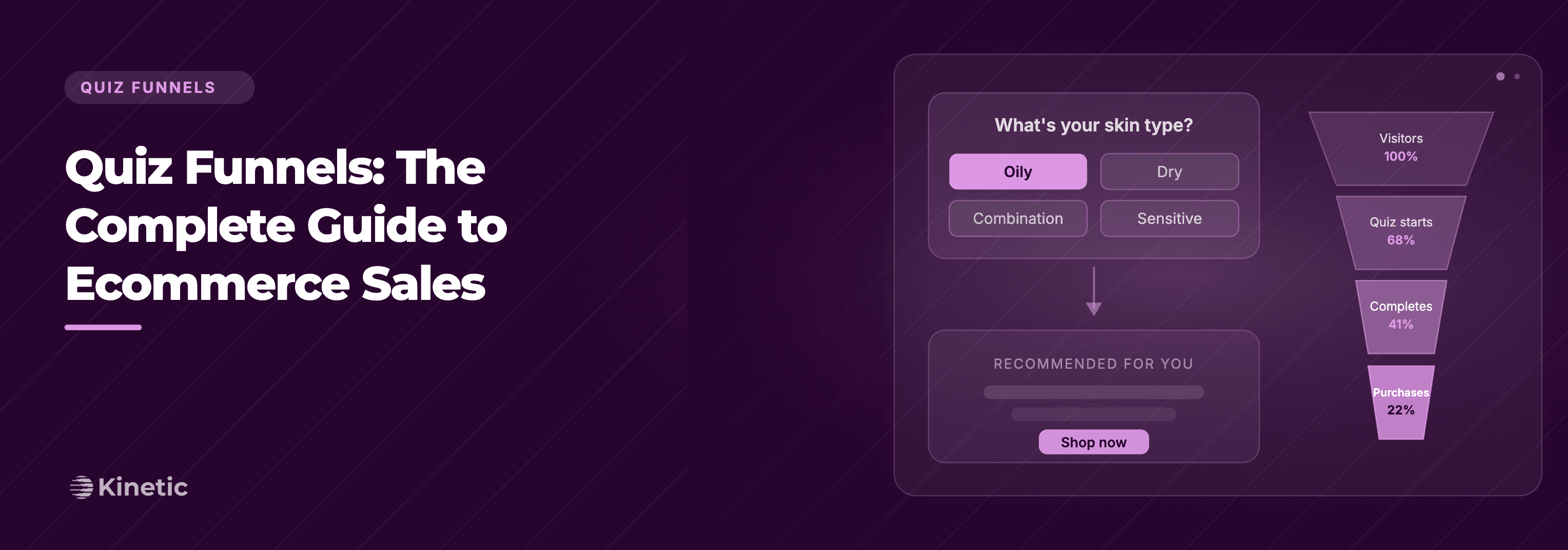
A quiz funnel is a four-step system that uses a short quiz to qualify a shopper, capture their email, match them to a product, and drop them into a personalized email flow that pushes the sale. Done right, the quiz alone converts 37.6% of ecommerce visitors into leads and 65% of starters finish all the questions, according to Interact's analysis of 80+ million quiz submissions.
Most brands stop at the quiz, which is a huge mistake. The quiz is step one of four. The funnel is where your revenue starts to increase.
This guide covers what a quiz funnel is, how the four stages fit together, why they outperform traditional ecommerce funnels, how to build one on Shopify, real examples worth studying, how to pick the best quiz funnel software for your stack, and the mistakes that are likely to kill conversion.
Inside this page
Share this
Summarize with AI
Key Takeaways
A quiz funnel is a four-stage path: quiz, email capture, product recommendation, and triggered email flow. Skip any stage and the funnel leaks revenue.
Ecommerce quiz funnels convert 37.6% of starters into leads and 65% of starters finish the quiz, roughly 10x a standard email pop-up.
The revenue lift isn't the quiz. It's the Klaviyo properties created by the quiz. Segmented lists return 3x the revenue per recipient, $0.19 vs. $0.06.
Pick quiz funnel software by four criteria: Shopify catalog sync, ESP property sync, where the quiz can run, and scoring logic that fits the catalog size.
Run the same quiz on your storefront and inside your emails to roughly double the response volume without doubling the build work.
What is a quiz funnel?
A quiz funnel is an ecommerce conversion path that swaps a static landing page for a short interactive quiz. A shopper answers 4 to 6 questions, gives up their email for the result, and gets a product recommendation plus a segmented email sequence that matches their answers. Four stages: quiz, capture, recommendation, flow.
The standard ecommerce funnel runs on browse-and-add-to-cart behavior. The quiz funnel runs on declared preferences. That single switch changes what the shopper sees next and what the brand knows about them forever.
A skincare brand asks five questions about skin type, concerns, and routine time. The shopper gets matched to a cleanser. Their answers become profile properties in Klaviyo. The next three emails they open already know they have oily, acne-prone skin and ten minutes in the morning. No retargeting pixel required.
How does a quiz funnel work?
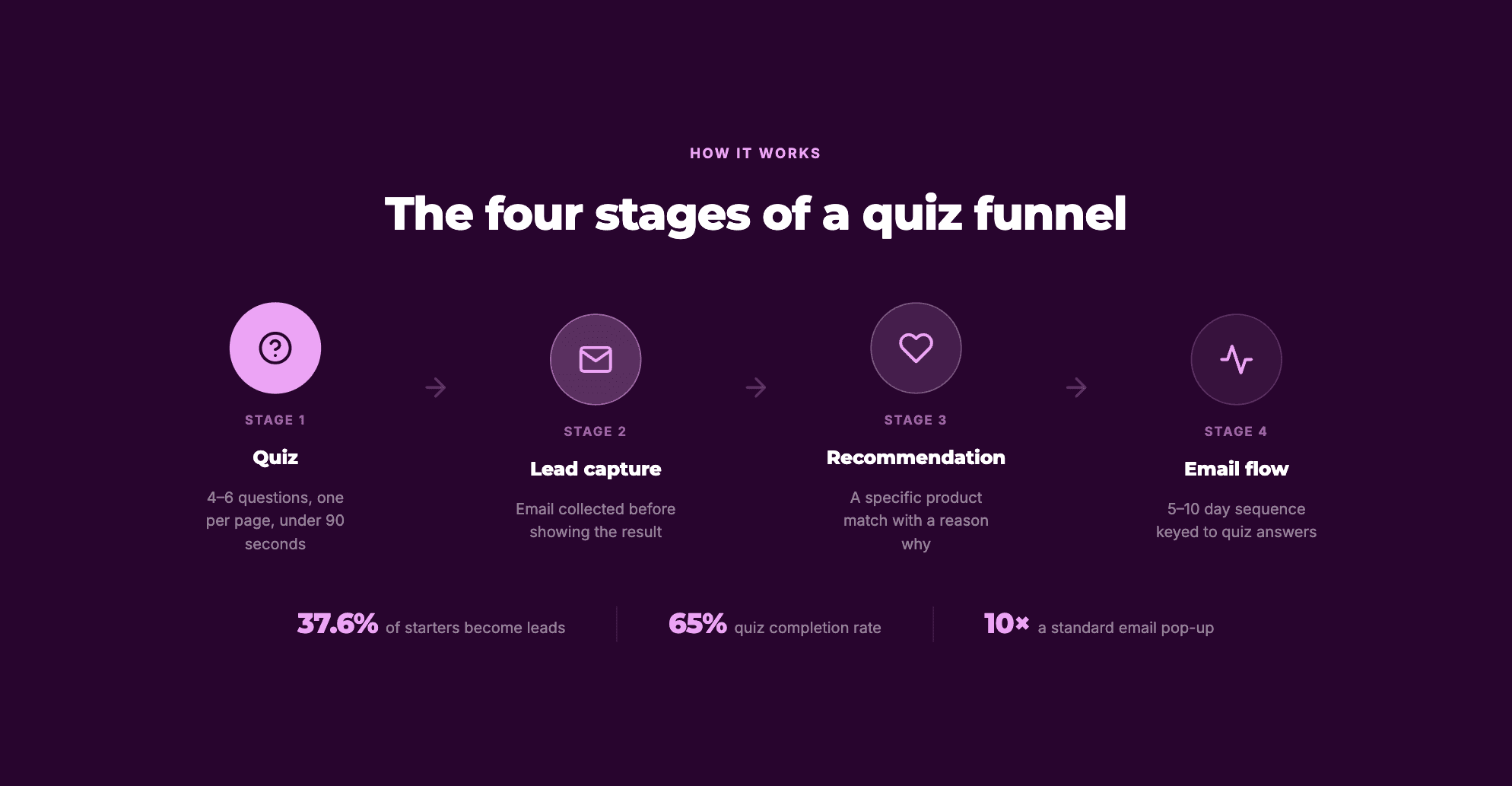
A quiz funnel works by collecting declared data upfront, using it to match a product, and then firing a personalized email flow that references those answers. The sequence is always the same: quiz question, answer captured as a profile property, product match surfaced on the results page, automated email flow triggered with content keyed to the answers.
Let’s have a look at it stage by stage.
Stage 1: The quiz (traffic in)
A paid ad, social post, homepage banner, or email drives traffic to the quiz. The quiz itself is 4 to 6 questions, usually one per page, finishing under 90 seconds. The shopper doesn't feel sold to because they're actively doing something.
Stage 2: The email capture
Toward the end (or right before the result), the quiz asks for an email address so the shopper can receive their personalized recommendation. This is the lead capture moment. Interact's ecommerce data puts the rate at 37.6%, which is roughly 10x a standard email pop-up.
Stage 3: The product recommendation
Each answer carries a weight or a tag. The quiz engine scores the answers and returns a product (or a bundle, or a top-three). The shopper lands on a results page with their match, and a discount or add-to-cart button.
Stage 4: The email flow
The answers push into Klaviyo (or your ESP) as profile properties. A flow triggers: day 0 confirmation, day 2 social proof for that specific product, day 4 objection handling, day 7 soft discount. Every email speaks to the shopper's actual answers, not a generic welcome series.
The data stays on the profile after the flow ends. That same "oily skin + 10-minute routine" answer segments a Black Friday campaign four months later.
Why quiz funnels convert better than standard ecommerce funnels
Three reasons, each measurable.
Shoppers self-qualify. A standard funnel drops every visitor on a category page and hopes they find the right product. A quiz funnel asks what they need and hands them a match. Baymard Institute tracks average cart abandonment at 70.22% across 50 ecommerce studies. A chunk of that abandonment is shoppers who added a product they weren't sure about. A quiz funnel reduces that "was this the right one?" hesitation before the cart even comes into play.
The email list is segmented on day one. Most brands collect an email with a generic "10% off" pop-up and segment later from open and click behavior. That's slow and noisy. A quiz funnel captures five segmentation attributes the moment the email hits the list. Klaviyo's benchmark report shows highly segmented lists return more than 3x the revenue per recipient of unsegmented lists, $0.19 vs. $0.06. Quiz data is the fastest way to earn that multiplier.
The flow can speak to the answer. Generic welcome flows read the same to everyone. A quiz-triggered flow reads like a conversation the shopper already started. "Since you mentioned oily skin" beats "Welcome to our brand".
Open rates, click rates, and conversion rates all lift when the email already knows something true about the reader.
Together, those three compound. Higher lead capture, faster segmentation, better flow performance. The funnel isn't just a single tactic, it should be thought about more as a backbone for your entire stack.
The anatomy of a high-converting quiz funnel
Good quiz funnels share six traits. Most failures are a missing piece rather than a broken one.
One clear decision. The quiz solves one thing. "Which moisturizer fits my skin?" works. "Tell us about your life" doesn't. Every question has to move the shopper closer to that single match.
4 to 6 questions, no more. Interact's quiz data shows completion rates hold steady through six questions and start to slip past that. Four is the sweet spot for most catalogs. Six should be your ceiling. You can always slowly add more questions and AB test in the future to see what works best for your brand.
One question per page. Multi-page forms keep the shopper committed. They also capture partial responses if someone bails before finishing, which gives you a remarketing list on autopilot.
A real recommendation, not a category. "Here's our oily skin line" is a category. "Here's The Daily Cleanser, recommended for you because you said oily and acne-prone" is a recommendation. The specificity is the whole point.
Email sync on every field. Each answer has to land in the ESP as a profile property. If the tool only captures the email and throws the rest of the data away, you don't have a quiz funnel. You have a quiz with a mailing list bolt-on.
A triggered flow, not a one-time email. The flow runs 5 to 10 days and references the specific answers. Without the flow, the quiz is a lead magnet. With the flow, it's a conversion engine.
Miss any of these and the funnel leaks. Get all six right and most of the work is done before traffic hits the quiz.
How do you build a quiz funnel on Shopify?
Building a quiz funnel on Shopify takes six steps: pick the decision you're solving, write 4 to 6 questions mapped to product tags, connect your catalog so recommendations pull real SKUs, sync every answer to Klaviyo as a profile property, build the triggered flow that references those properties, and drive traffic from one place at a time. Plan beats build.
1. Pick the single decision you want the quiz to solve
One decision. Not three. "Which cleanser?" not "Tell us about your skin goals."
The tighter the question, the shorter the quiz, the higher the completion rate. Brands that skip this step end up with 11-question quizzes that no one finishes.
2. Write 4 to 6 questions that each map to a product tag
Every answer option has to connect to a tag on a product. If your answers are "dry, oily, combination, sensitive" but your products are tagged "hydrating, clarifying, balancing," the match breaks. Write the answers and the tags together.
One trick: open a spreadsheet with questions in column A, answers in column B, and product tags in column C. If any cell in column C is empty, you've got an orphan answer that can't map to a recommendation.
3. Connect your Shopify catalog
The quiz tool should pull your live products, prices, and images automatically. Manual entry means stale data every time you launch a new SKU. Most serious quiz funnel software (including Kinetic, Octane AI, Quiz Kit, and RevenueHunt) connects directly to the Shopify catalog so recommendations always reflect what's in stock.
4. Sync every answer to Klaviyo as a profile property
This is the step where a lot of quiz funnels fall short. A quiz that captures the email but not the answers gives you a mailing list, not a segmented audience. You want each question to write to a named Klaviyo profile property ("skin_type," "routine_minutes," "main_concern") so you can filter on them in any future flow or campaign.
Kinetic writes every field to Klaviyo as a profile property by default. You set the naming conventions yourself, then every answer is directly synced to the Klaviyo profile. Whichever tool you pick, verify this is native, not a CSV export.
5. Build the triggered flow in Klaviyo
A basic quiz flow runs four to six emails over seven to ten days:
Day 0: Confirmation. "Here's your match plus a 10% code."
Day 2: Social proof for that specific product or category.
Day 4: Objection handling keyed to the top drop-off reasons.
Day 7: Final nudge with a soft discount.
Every email references the quiz answers. "Since you mentioned breakouts" beats a generic subject line every time. If you want the deeper build, our guide to advanced Klaviyo flows covers the conditional splits.
6. Send traffic from one source at a time
Pick one channel to feed the funnel first. A paid ad, a homepage banner, an email to your existing list. Measure completion rate and revenue per quiz starter. Add channels only after the funnel clears a baseline.
Running paid traffic to a funnel you haven't tested organically is the fastest way to burn ad budget on a leaky flow.
How do you choose the best quiz funnel software?
You should pick your quiz funnel software by how well it handles four things: Shopify catalog sync, ESP property sync, multi-surface deployment (site plus email), and scoring logic that matches your catalog complexity. Free tools can handle the basic quiz. Paid tools handle the most important aspects of the funnel. Most brands over-index on quiz features and under-index on the sync pipes that do the heavy lifting on the back end.
Here's a quick checklist:
Shopify catalog integration. The tool should pull live products automatically, including price, image, and inventory status. Manual CSV uploads break every time you launch a new SKU, and setting up Zapier connections can take time + extra expense and require constant monitoring.
ESP property sync. Every answer has to write to Klaviyo (or your ESP of choice) as a named profile property. Some tools only push tags, which limits how you can filter. Full control of your named properties are the difference between a simple quiz and a quiz funnel.
Where the quiz can run. The quiz belongs in at least two places: your storefront and your emails. A shopper who finds you through an ad might take the quiz on-site. A shopper who's already on your list should be able to take it inside an email without clicking to a landing page. In-email forms run at higher response rates because there's no extra click. Most quiz builders handle one surface or the other. Make sure to pick on that handles everything you need.
Common quiz funnel mistakes to avoid
Five patterns that quietly break a quiz funnel.
Treating the quiz like a survey. Surveys collect data. Funnels drive sales. If every question doesn't either narrow the product match or power a segmentation flow, cut it.
No flow after the quiz. A quiz without a triggered flow is a lead magnet. It captures emails and then sends them a generic welcome series. That's the biggest source of "quizzes don't work for us" stories.
Orphan answer options. Every answer has to map to at least one product tag. Orphans mean the shopper gives you an answer and you can't recommend anything based on it. Embarrassing on the results page.
Gating the result behind email, forcefully. Hard email gates can cost completions. A soft ask ("We'll email this result if you want to keep it") captures fewer emails per 100 starters but often more total conversions because completion rates stay high. This is something you should test for your brand and unique offer.
Running the quiz in one place only. A storefront-only quiz misses your existing email list. An email-only quiz misses every new visitors. Running quizzes on both surfaces increases the capture volume without doubling the build work, assuming the software supports it.
None of these are subtle. They show up in the completion rate data within the first week. If you're seeing a 25% completion rate when Interact's benchmark is 65%, work backward through this list first.
Conclusion
A quiz funnel isn't a quiz. It's four stages working together: the quiz pulls zero-party data, the capture turns a visitor into a lead, the recommendation earns the click, and the flow converts anyone who didn’t buy immediately. Skip any stage and the funnel gets leaky.
The tactical version is simple. One clear decision. Four to six questions. Real product matches. Klaviyo sync on every field. A triggered flow that references the answers. One traffic source at a time until the numbers clear a baseline.
If you want the full funnel built from in one tool, Kinetic allows you to create quiz funnels that live on your Shopify storefront and inside your Klaviyo emails (interactively) from a single build, with every answer mapped to a profile property.
FAQs
What is a quiz funnel in ecommerce?
A quiz funnel in ecommerce is a four-step conversion path that uses a short interactive quiz to qualify shoppers, capture their email, match them to a specific product, and trigger a personalized email flow that drives the sale. The quiz replaces a static landing page and turns declared preferences into segmentation data that powers every future campaign.
How effective is a quiz funnel?
Very effective when all four stages are built. Interact's analysis of 80+ million quiz submissions puts ecommerce quiz lead conversion at 37.6% and completion at 65%, roughly 10x a typical email pop-up. The multiplier holds only if the answers sync to your ESP and a triggered flow follows the quiz.
How much does a quiz funnel cost?
Quiz funnel software runs $0 to $500+ per month. Free tiers exist on Interact and Shopify App Store tools but strip out Klaviyo sync. Paid plans usually sit between $39 and $249/month for standalone quiz tools. Platforms that run the quiz inside emails (like Kinetic) start at $49/month. Price scales with responses collected, not features.
Can you build a quiz funnel without code?
Yes. Every major quiz funnel builder runs fully no-code: drag-and-drop question builders, visual product pinning, native Klaviyo integrations. Most ecommerce teams build a working quiz funnel in a day or two. The slow part isn't the build. It's the planning: writing tight questions, tagging products cleanly, and scripting the triggered flow.
What's the best quiz funnel software for Shopify?
There's no single winner. Interact is strongest for content-style quizzes at the low end. Octane AI and RevenueHunt fit enterprise catalogs. Quiz Kit sits mid-market. Kinetic is the one that runs the same quiz on your Shopify storefront and inside your Klaviyo emails from a single build. Match the tool to where your traffic actually lives.