
NPS Email: How to Send Net Promoter Score Surveys That Get Completed

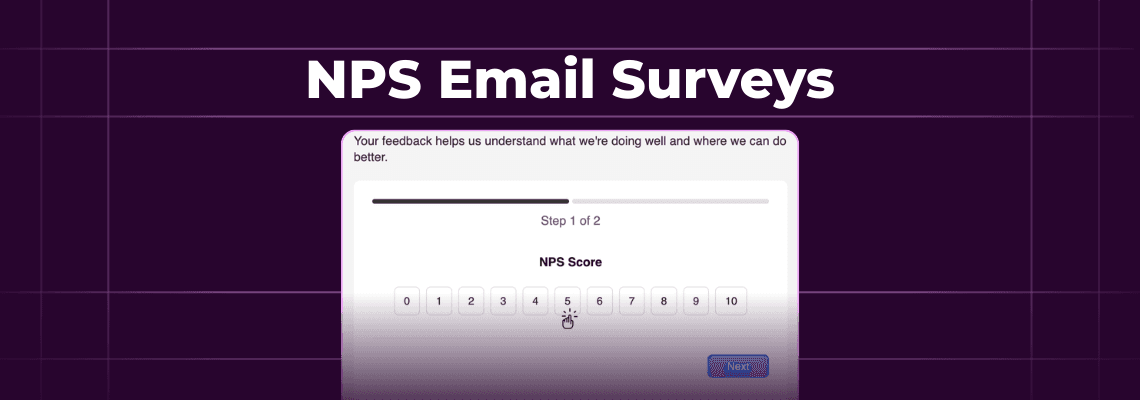
Here's a number that should bother you: the average NPS email gets somewhere between a 12% and 15% response rate. For every 1,000 customers you survey, 850 or more never tell you anything.
The question isn't the problem. It's been the same 0-10 scale since Fred Reichheld published it in Harvard Business Review back in 2003. Everyone recognizes it. The problem is delivery; when you send it, how you design it, and where the survey is located (friction).
This guide covers how to send NPS emails that ecommerce customers actually complete. You'll get timing by product type, design patterns that protect your completion rate, benchmarks to measure against, and what to do with scores once you collect them.
Inside this page
Share this
Summarize with AI
Key Takeaways
NPS emails average 12-15% response rates. But timing and delivery method can push completion past 30%. The question is standardized. The variable is how you send it.
Send 24-48 hours after delivery for physical products. Response rates drop 40% after the first week. Trigger from delivery confirmation, not purchase date.
NPS question first, one follow-up max, three questions total. The NPS question alone gets 89% completion. Each additional question costs 5-7% in drop-off.
Ecommerce NPS benchmarks: average 45-50, good 50-70, excellent 70+. Every 12-point increase correlates with 12% revenue growth.
Segment by score and follow up within 48 hours. Promoters convert at 40-50% for review requests. 50% of detractors churn within 90 days without intervention.
What Is an NPS Email?
An NPS email is any email that contains the Net Promoter Score question: "How likely are you to recommend [brand] to a friend or colleague?" Customers answer on a 0-10 scale, and their responses sort them into three groups that predict how they'll actually behave.
The three NPS segments:
Promoters (9-10): Loyal customers who refer others and buy again
Passives (7-8): Satisfied but not enthusiastic. One competitor offer away from switching.
Detractors (0-6): Unhappy customers who may damage your brand through word-of-mouth
Your NPS is the percentage of Promoters minus the percentage of Detractors. If 60% of respondents score 9-10 and 15% score 0-6, your NPS is 45. The scale runs from -100 to +100.
These segments aren't just labels. Bain & Company's research found that promoters carry 3x the lifetime value of detractors and generate 5x more referrals than passives. The score predicts behavior, not just sentiment.
For ecommerce brands, email is the default NPS channel because it fits nicely into post-purchase flows. Surveys trigger automatically after delivery, responses sync to customer profiles in your ESP, and the data feeds segmentation without manual effort. If you're exploring email surveys[ADD LINK TO EMAIL SURVEYS BLOG WHEN LIVE] for the first time, NPS is the easiest starting point because the question format never changes.
[IMAGE: Visual of the 0-10 NPS scale with color-coded segments showing Detractors (0-6, red), Passives (7-8, yellow), and Promoters (9-10, green) | Alt text: NPS scale from 0 to 10 showing detractor passive and promoter segments]
When Should You Send an NPS Email?
Send NPS survey emails 24-48 hours after delivery confirmation for physical products. For digital products, wait 3-7 days to give customers time to actually use what they bought. Getting this timing right matters more than your subject line or email design.
Transactional vs. Relational NPS
Two types of net promoter score email surveys serve different purposes. Transactional NPS fires after a specific event like a purchase or delivery. It measures how that particular experience went. Relational NPS goes out on a schedule, usually quarterly or biannually, to gauge overall brand health. For ecommerce, transactional NPS tied to post-purchase flows delivers more actionable data because you can tie scores to specific orders and products.
Timing by Product Type
Different products need different survey windows:
Fashion and apparel: 5-7 days. Customers need time to try items on and decide if they're keeping them.
Beauty and personal care: 7-14 days. The product needs to be used before anyone can rate it honestly.
Food and consumables: 24-48 hours. Freshness is a key part of the experience, and memory fades fast.
Electronics: 3-5 days for simple products. 7-14 for anything with a setup process or learning curve.
Build It Into Your Post-Purchase Flow
The most effective NPS emails aren't standalone campaigns. Build them into your post-purchase automation:
Delivery + 24-48 hours: Send NPS survey
Day 3: Reminder to non-responders only
Day 7: Segment-specific follow-up based on score
Trigger from delivery confirmation, not purchase date. That distinction matters because shipping delays would mean surveying customers who haven't received anything yet.
One universal rule: don't survey the same customer more than once every 90 days. Survey fatigue kills response quality faster than it kills response rates.
What Is a Good NPS Score for Ecommerce?
The average ecommerce NPS falls between 45 and 50. Above 50 is good. Above 70 is excellent. But the trend over time matters more than any single snapshot, so track monthly and watch the direction.
Here's how benchmarks break down by vertical, based on Survicate’s NPS benchmark report:
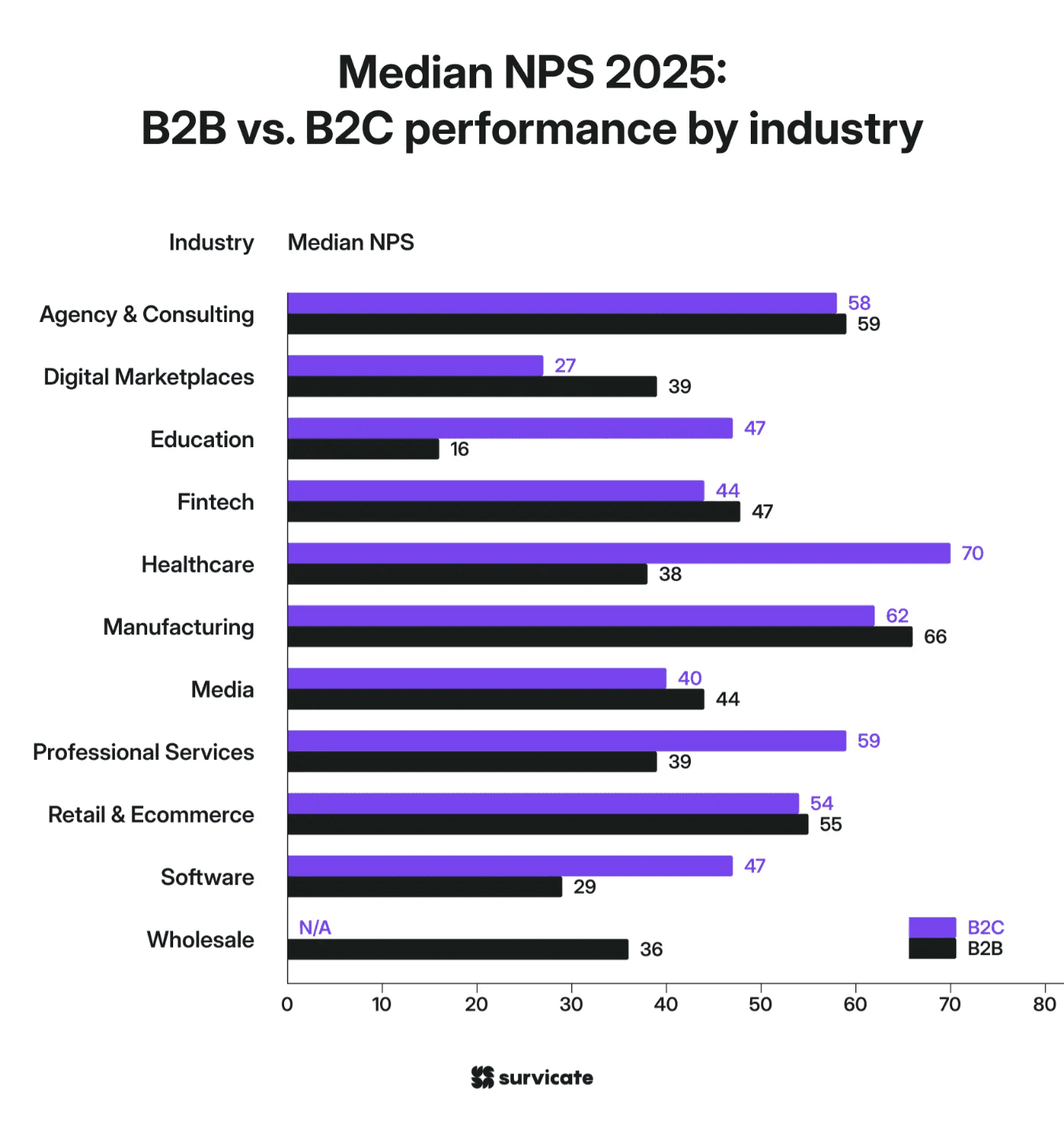
The business impact is measurable. Bain & Company found that every 12-point NPS increase correlates with 12% revenue growth.
Don't obsess over hitting a specific benchmark number, though. Track your NPS monthly, look for directional trends, and focus on the gap between where you are and where your best-performing months land. A 10-point improvement over six months means more than a static 55 that never moves.
Can You Embed an NPS Survey Directly in Email?
Yes. Interactive email technology lets customers tap their NPS score and answer follow-up questions without ever leaving their inbox. Instead of clicking through to a survey page, they complete everything inside the email itself.
The response rate gap between these two approaches is where it gets interesting. Linked NPS surveys, where customers click through to SurveyMonkey, Typeform, or Google Forms, typically get 5-15% completion among email openers. Dr. Emi Arpa Skin, a skincare brand, tested both approaches with the same questions and the same audience. The embedded version produced 188% higher response rates.
Three rendering paths make this work, loading automatically based on each subscriber's email client:
Interactive HTML/CSS renders in Apple Mail, covering roughly 51.5% of email opens
AMP for Email renders in Gmail and Yahoo, covering about 29% of opens
Static fallback for Outlook and others (~19%), showing a preview with a link to complete on a web page
For most D2C email lists, 80%+ of subscribers see the fully interactive version. Kinetic is one platform that builds these in-email NPS surveys, with a no-code editor that pushes directly to your ESP. Responses sync to customer profiles as zero-party data you can segment on immediately.
NPS is actually the ideal use case for embedded surveys. The question is always the same 0-10 scale. You don't need conditional branching logic. Two or three questions covers everything. If you're on Klaviyo, our Klaviyo survey setup guide covers the full integration.

What Should You Do After Collecting NPS Scores?
Segment responses by score and trigger automated follow-up workflows within 48 hours. The number alone is useful for benchmarking against industry averages, but the real value of NPS comes from acting on each segment with a different playbook.
Promoters (9-10): Turn Them Into Advocates
Ask for a review within 24 hours of their NPS response. Promoters are the most likely group to leave a review when asked right away. Invite them into your referral program. Share user-generated content opportunities. These customers are already enthusiastic. Give them a channel for it.
Passives (7-8): Your Highest-ROI Segment
Passives generally make up 40 - 50% of your segmentation. They're satisfied but not excited. And small improvements shift them to promoters at scale. Read their open-ended responses carefully. Send targeted follow-ups addressing the specific friction they flagged.
Detractors (0-6): Speed Matters
Research shows that 50% of detractors churn within 90 days without intervention. 82% are likely to then tell other people about their experience. Customer service outreach within 24-48 hours can turn complaints into retention. Track whether detractors who receive follow-up end up purchasing again.
The pattern across all three: don't just collect scores. Close the loop by acting.
Send NPS Emails That Customers Actually Finish
NPS only works when enough people respond. And the delivery method determines that more than anything else.
Start with timing. Trigger your NPS email from a post-delivery event, not a batch campaign sent on a random Tuesday. Keep it to 2-3 questions. Personalize the subject line. And if you're stuck at 10% response rates with linked surveys, test an embedded version. The gap between the two methods is the single biggest lever most ecommerce brands haven't pulled yet.
Try building an in-email NPS survey with Kinetic →
FAQs
How do you calculate NPS?
Subtract the percentage of Detractors (scores 0-6) from the percentage of Promoters (scores 9-10). Passives (7-8) don't factor into the calculation. If 60% of your respondents score 9-10 and 20% score 0-6, your NPS is 40. The score ranges from -100 to +100, with anything above 50 considered good for ecommerce brands. Track monthly and watch the trend rather than fixating on a single number.
How often should you send NPS surveys?
No more than once every 90 days to the same customer. For transactional NPS tied to post-purchase flows, trigger based on delivery events rather than a fixed calendar schedule. For relational NPS measuring overall brand health, quarterly or biannual sends work best. Rotate NPS with other feedback types like CSAT and product reviews to get a fuller picture without burning out your list.
What is the best subject line for an NPS email?
Short, personalized, and direct. Keep subject lines under 50 characters and include the customer's name or a product reference. Examples: "[Name], one quick question about your order," "How was your [product name]?" and "Quick: rate your experience (takes 10 seconds)." Personalized subject lines see 26% higher open rates than generic ones.
What is the difference between transactional and relational NPS?
Transactional NPS surveys fire after a specific event like a purchase or delivery, measuring satisfaction with that one experience. Relational NPS surveys go out on a regular schedule (quarterly or biannually) to measure overall brand loyalty over time. For ecommerce, transactional NPS tied to post-purchase flows gives you more actionable data because you can connect each score to a specific order, product, and delivery experience.