
Product Recommendation Quiz: How Ecommerce Brands Use Them to Convert Browsers Into Buyers

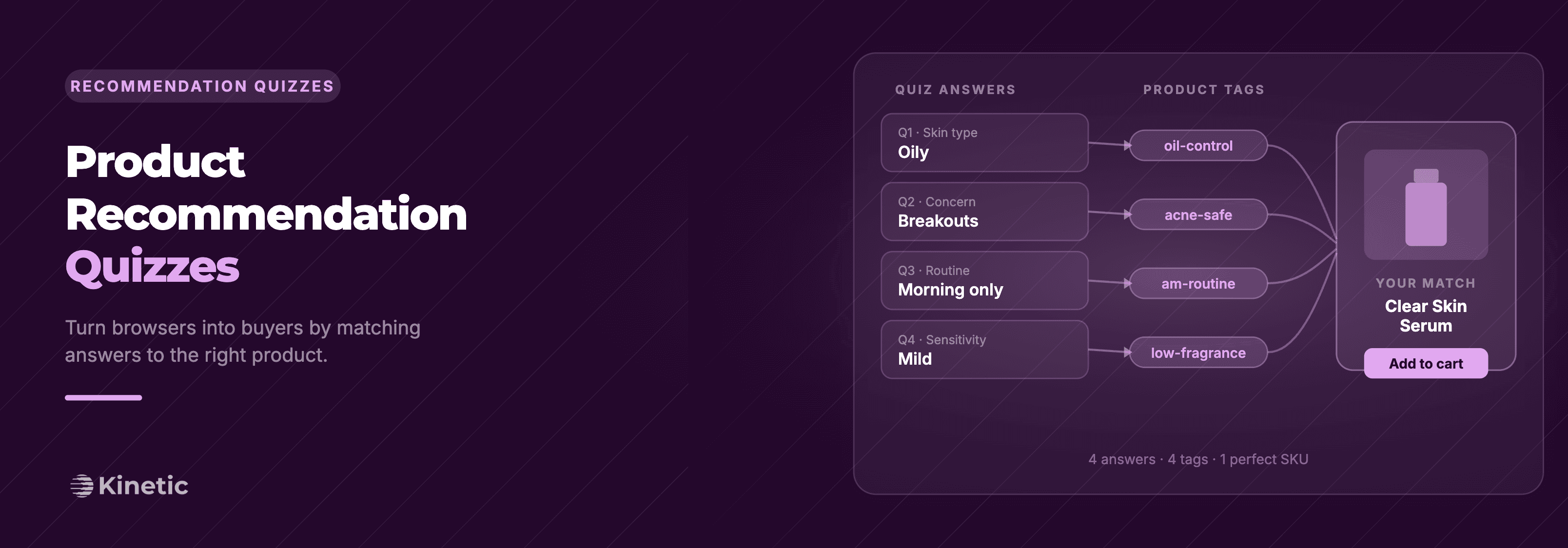
A product recommendation quiz asks a shopper 4 to 6 questions, then matches them to the SKU that actually fits. Done well, it can convert 37.6% of starters into leads and complete at 65%, according to Interact's analysis of 80+ million quiz submissions.
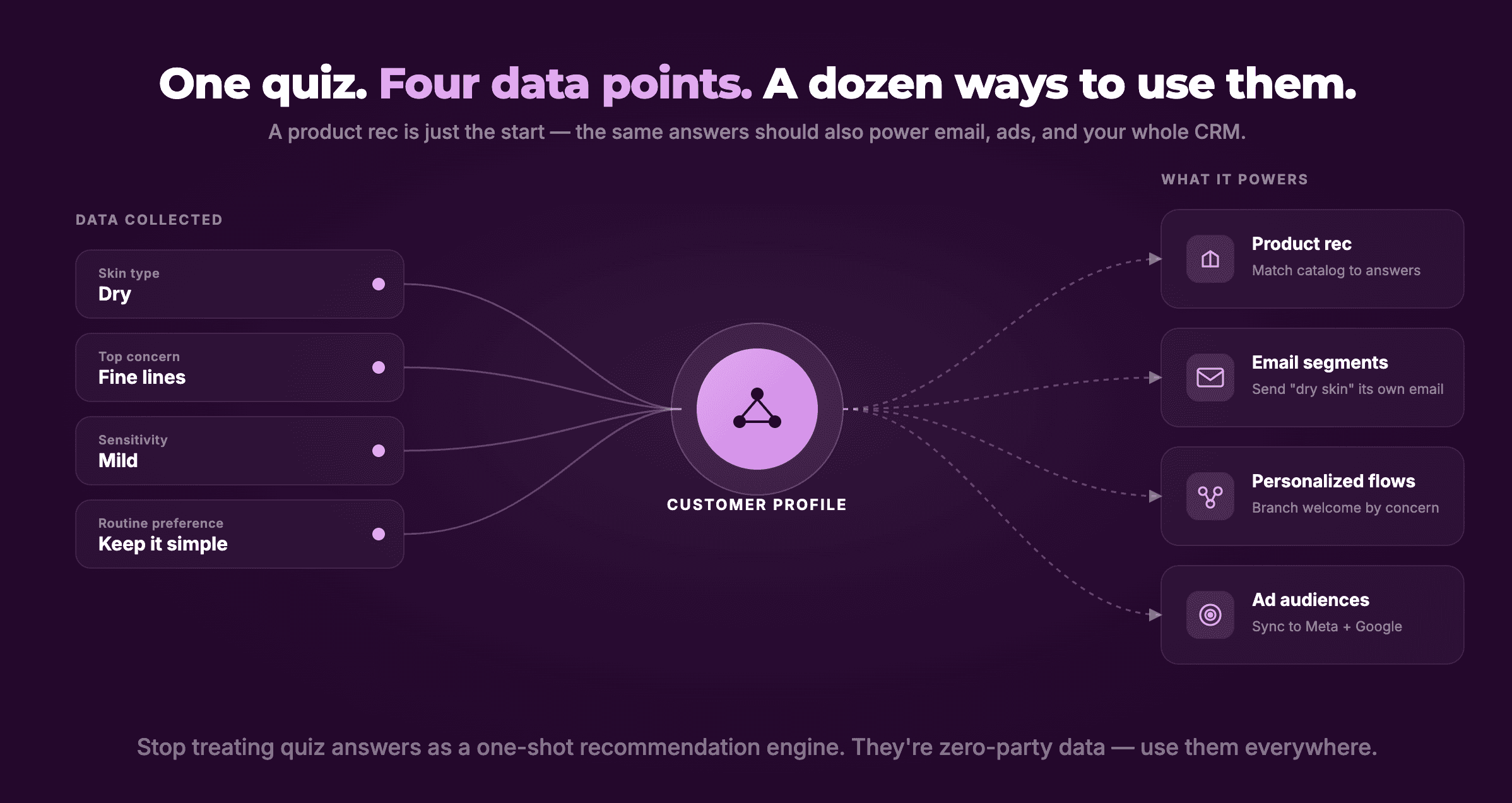
Most ecommerce brands treat quizzes as a lead-capture gimmick. The brands pulling real revenue from them treat the quiz as a data layer. Every answer becomes a profile property. Every property unlocks a smarter Klaviyo flow and a cleaner winback series.
This guide covers what a product recommendation quiz is, why they work for ecommerce, how to build one, the questions that convert, brand examples worth stealing from, and what to look for in a tool.
Inside this page
Share this
Summarize with AI
Key Takeaways
Product recommendation quizzes use 4 to 6 questions to match shoppers to a specific SKU. Past 6, completion rates slide.
Ecommerce quizzes convert 37.6% of starters to leads and complete at 65%, roughly 10x a typical email pop-up.
The real ROI is zero-party data for segmentation and personalization. Every answer becomes a filterable profile property in your ESP.
Point-based scoring works for most catalogs. Add weighted or branching logic only after real drop-off data tells you to.
Run the quiz on both your storefront and inside your emails. No sync to Klaviyo means the quiz stops paying off after the first visit.
What is a product recommendation quiz?
A product recommendation quiz is a short interactive form that asks shoppers a few questions about their needs, preferences, or goals, then uses their answers to recommend a specific product from your catalog. Most run 4 to 6 questions and finish in under 90 seconds.
The shopper gets a personalized pick instead of scrolling through 200 SKUs. The brand gets zero-party data the shopper gave up willingly: skin type, dog breed, coffee preference, fitness goal, gifting occasion. That data sits on the customer profile forever and powers every future campaign.
Product recommendation quizzes show up in a few common formats. Skincare brands build skin-type quizzes. Supplement/fitness brands build goal-based routines. Pet brands ask about breed, age, and dietary concerns. Coffee brands ask about brew method and roast preference. The mechanic is always the same: question, answer, product match.
Why product recommendation quizzes work for ecommerce
They cut choice overload, for starters. A Shopify catalog with 100+ SKUs is the paradox of choice in action, and a quiz replaces "browse 200 products" with "here's your top pick."
They also generate leads at rates landing pages can't match. Interact's 37.6% lead conversion figure for ecommerce quizzes is roughly 10x a typical email pop-up. Shoppers don't see a quiz as interruptive the way they see a pop-up. You provide them with a real benefit (time saved browsing) and they provide you with data and (hopefully) a purchase.
And the zero-party data compounds. A skin-type answer today is a segmented abandoned-cart email next week and a personalized Black Friday subject line four months later. Klaviyo's benchmarks show segmented lists earn $0.19 per recipient versus $0.06 for unsegmented sends, roughly 3x the revenue per send. Quiz answers give you these segments.
How to create a product recommendation quiz
Planning beats building. If you skip the planning, you end up with an 11-question quiz that nobody finishes. Work through these six steps before you open a quiz builder.
Start with one customer problem you want to solve
Pick the single decision your catalog forces on shoppers. For a skincare brand, that's probably "which product is right for my skin type?" For a supplement brand, "which stack matches my goals?" For a pet food brand, "what should I feed a senior dog with a sensitive stomach?"
Pick one problem to start, and build your quiz from there.
Pick 4 to 6 questions and no more
Interact's conversion data shows completion rates hold steady through six questions and slide past that. Start with four. Add more only after you measure drop-off by question.
Every question has to either narrow the product match or feed a segmentation rule you'll actually use. If a question doesn't do one of those, remove it.
Choose your recommendation logic
Three common approaches:
Point-based scoring gives each answer a point toward specific products. Highest-scoring product wins. Simple, works well under 100 SKUs.
Weighted scoring assigns different point values to different answers. Useful when some answers are more decisive (a severe skin concern outweighs a scent preference).
Branching logic changes follow-up questions based on prior answers. Best for large catalogs where the quiz needs to eliminate entire product categories early.
Start with point-based. Add weighting or branching only after real completion data tells you where shoppers drop off.
Decide where the quiz runs
Most brands run a product recommendation quiz in one of three places: on a dedicated landing page, as a site pop-up or homepage embed, or inside an email. Each pulls a different audience.
A landing page quiz converts paid traffic you send to it. A site embed catches warm browsers before they leave. An in-email quiz meets existing subscribers inside the inbox, or catches those who come through without touching your other quizzes or surveys.
Running the same quiz across both a website and email gives you the widest capture. Kinetic is one of the few tools that lets a single quiz run in both surfaces: build it once, embed the snippet on your Shopify storefront, and drop the same form inside your Klaviyo welcome series. Responses from both locations land in the customer’s Klaviyo profile as custom properties.
Sync answers to your ESP for segmentation
This is where most of the revenue comes from. If your quiz tool only captures emails and doesn't push answer data into Klaviyo as profile properties, you've built a lead-gen form, not really a product recommendation quiz.
Make sure every question maps to a Klaviyo property. "Skin concern" becomes a profile property you can filter on in any future flow. Klaviyo segmentation that starts with quiz data runs laps around segmentation based on opens and clicks alone.
Product recommendation quiz questions that actually convert
Good quiz questions do two things at once: they narrow the product match and they collect useful zero-party data. Here are question patterns that work across the most common ecommerce verticals.
Skincare and beauty
What's your main skin concern right now? (dryness, breakouts, dullness, fine lines, sensitivity)
How would you describe your skin type? (oily, dry, combination, sensitive)
How much time do you realistically spend on your routine? (under 5 min, 5-10 min, 10+ min)
Supplements and wellness
What's the main health goal you want to focus on this quarter? (sleep, energy, digestion, focus, stress)
How often do you currently take supplements? (never, occasionally, daily routine)
Any dietary preferences we should know about? (vegan, gluten-free, no caffeine, none)
Coffee and specialty food
How do you usually brew? (drip, espresso, French press, pour-over, cold brew)
How do you like your roast? (light, medium, dark, I don't know yet)
Pet care
What's your dog's age? (puppy, adult, senior)
Any sensitivities? (grain, chicken, dairy, none we know of)
How active is your dog? (low, moderate, high)
Home and lifestyle
Who are you shopping for? (myself, a gift, my home)
What's your price comfort zone? (under $50, $50-$150, $150+)
Notice what each question does. It narrows the match AND it creates a filterable Klaviyo property you can use in every future flow. The "skin concern" answer isn't just for this quiz. It's segmenting next month's promo or splitting users into different flows.
What to look for in a product recommendation quiz tool
Five things worth checking before you commit:
Shopify catalog integration. Can the tool pull your real products with prices and images, or does it require manual entry? Manual entry means stale data every time you launch a new SKU.
ESP sync depth. Does every answer push to Klaviyo as a profile property? Some tools only capture emails. That's not enough.
Distribution surfaces. Can the quiz run on your storefront and inside your emails, or are you locked to one? Brands running both capture significantly more responses.
Scoring flexibility. Point-based works for most catalogs. If you have 500+ SKUs or complex feature matching, look for weighted scoring or branching.
Analytics. You want drop-off-per-question data, not just completion rate. Drop-off tells you which question is killing the quiz.
For a side-by-side of the main Shopify options, we broke down seven tools in Shopify quiz apps compared. Interact is strong for content-style quizzes. Octane AI fits enterprise catalogs. Quiz Kit sits mid-market. Kinetic is the one built for brands running quizzes inside Klaviyo emails and on a Shopify storefront from a single build.
Common product recommendation quiz mistakes
A few patterns that kill conversion.
Too many questions. Anything past 6 starts bleeding shoppers. If you need more data, split it across a welcome quiz and a later post-purchase survey.
Generic answer options. "Sometimes," "often," and "rarely" don't map to products and can be difficult to segment your audience with. Try to be as specific as possible.
Orphan answers. Every option should tie to at least one product. If it doesn't, you’re wasting a data point.
Gating results behind email. Hard gates cost completions. Test ungated results with a soft email ask on the results page instead.
Running in one place only. Email-only quizzes miss new visitors. Site-only quizzes miss subscribers. Run the quiz in both places and the responses add up fast.
Conclusion
A product recommendation quiz is a trade. The shopper gives you four or five answers. You give them a confident pick plus a reason to come back. The brands that win this trade treat the quiz as infrastructure, not a campaign or gimmick. Every answer feeds segmentation. Every segment lifts the next flow.
The tactical version is simple: one clear decision to solve, 4 to 6 questions, answers that map to products, scoring logic you can defend, Klaviyo sync on every field, and a quiz that runs both on-site and in-email.
If you want the first draft written for you, Kinetic builds product recommendation quizzes from a Shopify URL for you to embed inside emails and on your storefront. One click and you receive a fully functioning and optimized quiz with product recommendations from your own store.
FAQs
What is a product recommendation quiz?
A product recommendation quiz is a short interactive form, usually 4 to 6 questions, that collects shopper preferences and returns a personalized product match from the brand's catalog. It replaces open-ended browsing with a guided result, and the answers become first-party data for future segmentation.
How many questions should a product recommendation quiz have?
Four to six questions works best. Interact's conversion data across 80 million quizzes shows completion rates hold steady through six questions, then drop noticeably past that. If you need more data, split across a welcome quiz and a later preference survey instead of one long form.
How do product recommendation quizzes collect zero-party data?
Every answer a shopper gives is zero-party data by definition: volunteered, contextual, permission-based. The quiz asks, the shopper answers, and each response maps to a profile property in your ESP. Skin type, dietary preference, or fitness goal answers become filters for every future campaign.
Can you build a product recommendation quiz on Shopify?
Yes. Most Shopify brands use a dedicated quiz app (Kinetic, Octane AI, Quiz Kit, Interact, RevenueHunt) rather than building one from scratch. Look for one that pulls your Shopify catalog automatically, syncs answers to Klaviyo as profile properties, and runs on both the storefront and inside your emails.
What's the difference between a product quiz and a product finder quiz?
They're the same tool under different names. "Product finder quiz" emphasizes the discovery outcome. "Product recommendation quiz" emphasizes the match itself. Both ask questions, both return a product, and both work best when answers sync to your ESP for segmentation.