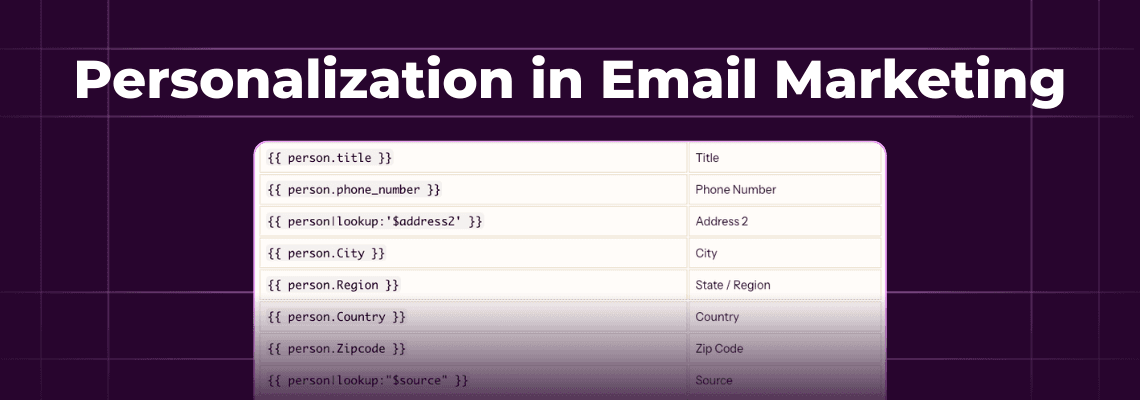
Personalization in Email Marketing: The Complete Guide (Updated 2026)

Here's a number that should bother you: 81% of consumers flat-out ignore marketing messages that don't feel relevant to them.
Think about that for your own list. Four out of five subscribers are mentally deleting your email before they finish reading the subject line. Not because your product is bad. Because your email felt like it was written for everybody, which means it was written for nobody.
Personalization in email marketing is how you fix that. And no, sticking someone's first name in the subject line doesn't count. Real personalization means tailoring your content, product recommendations, and send timing to each subscriber based on data they've shared with you or behaviors you've observed.
This guide covers what email personalization actually looks like in practice, the data you need to do it well, seven strategies eCommerce brands are using right now to drive more revenue, and the mistakes that'll get you marked as spam (or worse, creepy). Let's get into it.
Inside this page
Share this
Summarize with AI
Key Takeaways
Personalization in email marketing goes far beyond first-name merge tags. It means tailoring content, product recommendations, and timing based on real subscriber data and behavior.
Personalized emails achieve 29% open rates (vs. 21% average) and 41% higher click-through rates, with targeted campaigns driving 58% of all email revenue.
Zero-party data (information customers voluntarily share) is the most accurate foundation for personalization and increasingly important as third-party cookies disappear.
Start with a welcome survey and a few audience segments before building out advanced behavioral triggers. Small, well-targeted efforts outperform complex setups with bad data.
Common mistakes include personalizing with stale data, stopping at subject lines, referencing sensitive browsing behavior, and over-segmenting into groups too small to learn from.
What is personalization in email marketing?
Personalization in email marketing means tailoring your email content, timing, and offers to individual subscribers based on data you've collected about them. It goes well beyond inserting a first name into a subject line, though you'd be surprised how many brands think that still counts as "personalized."
Think of it as a spectrum.
Basic personalization is merge tags. First name in the greeting. Maybe their city. It's better than nothing, but your subscribers most likely stopped being impressed by this around 2018.
Intermediate personalization is where most good eCommerce brands operate today. You're segmenting by purchase history, browsing behavior, or preferences people have shared with you. A customer who bought running shoes last month sees trail running accessories in their next email. Not stilettos.
Advanced personalization is predictive or based on zero-party data. You're using purchase patterns to anticipate what someone wants next, sending at the exact hour they're most likely to open, and triggering emails based on real-time behavior or preferences the customer has shared with you. This is where email stops feeling like marketing and starts feeling like a recommendation from a friend who happens to know your size and favorite colors.
The brands doing this well aren't necessarily spending more time on email. They're spending more time up front on data that pays off well into the future.
What Changed in 2026
Personalization isn't a new idea. But the landscape around it is shifting fast.
According to Klaviyo's April 2026 research, 60% of consumers now interact with AI at least weekly. On the brand side, 73% of B2C marketers are already using or exploring AI to personalize messaging, and 66% are doing the same for product recommendations.
So AI-powered personalization is everywhere. The problem is trust hasn't kept up.
Only 13% of consumers completely trust AI. And 21% say they feel uncomfortable when AI sounds too human or "pretends" to know them. That's roughly 1 in 5 people actively put off by the thing most brands are rushing to implement.
This creates a real tension. Brands have more personalization tools than ever, but consumers are more skeptical of how those tools are being used on them. The brands pulling ahead aren't the ones with the most sophisticated AI. They're the ones letting customers control the inputs. When someone tells you their skin type, their budget, or their style preference through a quiz or survey, you're not guessing. You're responding with information they actively told you.
The subsequent personalization you create is based on a relationship you started with the customer, and they know how you got this information.
This makes a huge difference, and can turn personalization that feels like surveillance into personalization that feels helpful.
Why does email personalization drive more revenue?
Personalized emails generate more opens, more clicks, and more purchases than generic blasts. The data here isn't subtle.
Personalized emails achieve 29% open rates compared to the 21% industry average. They generate 41% higher click-through rates. And targeted, personalized campaigns drive 58% of all email revenue, according to data from Benchmark Email and Mailmodo.
Those aren't small differences. That's the gap between email being an afterthought and being your highest-ROI channel.
But here's what gets overlooked: generic emails are actively hurting your sender reputation. When subscribers ignore your messages consistently, inbox providers notice. Your deliverability drops. You're paying to reach fewer people with every send.
78% of marketers rank subscriber segmentation as their single most effective email strategy. Not subject line tricks. Not send-time experiments. Segmentation. Getting the right message to the right person.
From the other side of the inbox, 73% of consumers expect brands to understand their specific needs. When you blast the same promotional email to your entire list, you're telling nearly three-quarters of your audience that you don't know who they are. Or don't care.
Email marketing already delivers $36-40 for every $1 spent. Personalization is how you push that number higher without spending more.
What data do you need to personalize emails?
Good personalization runs on good data. Bad data is how you get the "Congratulations on your pregnancy!" email sent to a 65-year-old man. So let's talk about what data actually matters and where it comes from.
There are two types worth collecting. And one type that's dying.
Zero-party data: what customers tell you directly
Zero-party data is information customers voluntarily share with you. Their preferences, sizing, skin type, how often they want to hear from you, what they're shopping for. Forrester coined the term, and it's become the gold standard for personalization because it comes straight from the source.
The beauty of zero-party data is accuracy. You're not guessing what someone wants based on a page they visited for three seconds. They told you. "I have dry skin." "I run, not cycle." "I'm shopping for gifts, not myself."
This is the data that powers the most effective email segmentation and personalization strategies. It reflects real intent, not inferred behavior.
First-party data: what you observe from behavior
First-party data comes from your own channels. Purchase history, email engagement, browsing patterns on your site, products added to cart, review submissions. Your ESP is already collecting most of this.
One thing to note: behavioral data tells you what someone did, not why. A customer browsing winter coats might be planning a ski trip. Or they might be killing time on their lunch break. When you pair first-party data with zero-party data, you get a much clearer picture.
Why third-party data is fading out
Third-party cookies are on life support. Privacy regulations like GDPR and state-level laws across the US keep tightening. And 99% of marketing executives say data privacy concerns have changed their personalization plans, per the 2025 Braze Global Customer Engagement Review.
The brands pulling ahead at personalization aren't mourning the loss of tracking pixels. They're asking customers directly and building richer profiles from zero-party data instead.
How do you collect personalization data?
The best way to collect personalization data is to make it feel natural. Nobody wants another generic 15-field form covering multiple areas. The approaches that work either give customers something in return for sharing, or make the act of sharing so frictionless they barely notice.
People aren’t adverse to sharing details about themselves as a rule, and you could even argue that they enjoy it (see: social media over the last decade). What they don’t like is monotonous extra steps. Make it easy or enticing for them to share!
Welcome surveys and preference centers
The moment someone joins your list is the easiest time to ask questions. They just opted in. They're interested. A two-question welcome survey asking about their preferences or what they're shopping for gives you enough to personalize their very first campaign.
Preference centers let existing subscribers update what they care about. Most brands build one and forget about it. The good ones actively drive traffic to it through quarterly email surveys that keep data fresh.
Post-purchase feedback
After someone buys, they're primed to share. How'd the product fit? Would they recommend it? What are they shopping for next?
This data is gold because it comes with purchase context. You know what they bought, and now you know how they felt about it. NPS surveys embedded in post-purchase emails capture satisfaction scores that help you segment promoters from detractors and adjust your messaging for each group.
In-email forms and quizzes
Here's where most data collection falls apart. You ask someone to click a link, leave their inbox, wait for a page to load, and then fill out a form. Every step loses people.
Tools like Kinetic let you embed forms and quizzes directly inside the email itself. Subscribers answer without leaving their inbox, and responses sync straight to their Klaviyo profile for immediate segmentation. It cuts out the friction that kills most data collection efforts.
Behavioral tracking from your ESP
Your email platform already knows who opens, who clicks, who buys, and who's gone quiet. Use that data. Build browse abandonment flows. Segment by engagement level. Track which product categories each subscriber gravitates toward.
Dynamic content blocks in Klaviyo let you show different products, copy, or offers to different segments within the same campaign. Same send. Different experience for each reader.
7 email personalization strategies that actually work
These are ordered roughly by impact and ease of implementation. Start at the top and work down.
1. Segment by stated preferences, not just demographics
Demographics tell you who someone is. Preferences tell you what they want. A 35-year-old woman in Austin could be shopping for herself, her kids, or her spouse. Age and zip code don't tell you which.
Ask directly. Use welcome surveys, post-purchase follow-ups, or in-email preference quizzes to learn what people actually care about. Build your segments around those answers, not just what's in your CRM by default.
2. Use dynamic content blocks
Same email, different content for different people. That's dynamic content in practice. Your VIP customers see early access to a sale. First-time buyers see a getting-started guide. Lapsed subscribers see a win-back offer.
You don't need to build separate campaigns for each segment. One email with swappable content blocks does the heavy lifting.
3. Trigger emails based on real-time behavior
Browse abandonment. Cart abandonment. Post-purchase cross-sells. Win-back sequences. These fire based on what someone did (or didn't do), which makes them feel relevant by default.
One mid-market apparel retailer found that three personalized flows (browse abandonment, fit tips, loyalty win-backs) grew to represent 38% of their total email revenue within 60 days. Those flows made up less than 3% of their total sends.
That's the ratio you're after. A small number of hyper-relevant emails driving a disproportionate chunk of revenue.
4. Personalize product recommendations
If someone bought a moisturizer, they probably need a cleanser. If they bought running shoes in size 10, show them running socks in the right size. Not generic bestseller lists. Specific products that make sense given what they already own.
Product recommendation emails work because they skip the guesswork and show people things connected to purchases they've already made.
5. Match messaging to lifecycle stage
A new subscriber needs education and trust-building. A repeat buyer needs loyalty perks and early access. A lapsed customer needs a reason to come back. Sending the same content to all three is a waste.
Map your email flows to lifecycle stages: new subscriber, first purchase, repeat buyer, VIP, at-risk, lapsed. Each stage gets messaging that matches where that person actually is in their relationship with your brand.
6. Personalize send times
Not everyone checks email at 9am on Tuesday. Most ESPs now offer send-time features that deliver emails when each individual subscriber is most likely to open.
It's a small change that compounds. Even a 5-10% lift in open rates adds up across every campaign you send for the rest of the year.
7. Re-engage based on survey feedback
When someone gives you a low NPS score or negative feedback, don't keep hitting them with the same promotional cadence. Route them into a different flow. Address their concern. Offer a resolution.
When someone tells you they love your brand (high NPS, positive review), ask for a referral or a public review. Match your follow-up to their sentiment data from survey responses.
Personalization mistakes that kill trust
Getting personalization wrong is worse than not doing it. Here's what trips brands up.
Using data you shouldn't reference. If someone browsed a sensitive product category, think carefully before calling it out in an email. "We noticed you were looking at anxiety supplements" is technically accurate and completely trust-destroying.
Personalizing with stale data. That customer who bought baby clothes two years ago? Their kid isn't a baby anymore. Profiles need regular refreshing, which is one more reason periodic preference surveys matter. Data rots if you don't maintain it.
Stopping at the subject line. "Hey Sarah!" followed by a completely generic email body is worse than no personalization at all. It signals you have the data but can't be bothered to use it past the greeting.
Ignoring consent. This one's non-negotiable. Every data collection point should make it clear what you're collecting and why. Privacy regulations keep tightening globally. Consumer trust, once broken, is almost impossible to rebuild.
Over-segmenting into uselessness. If your segments are so narrow that each one contains 50 people, you don't have enough volume to learn what works. There's a sweet spot between "everyone gets the same blast" and "every subscriber gets a unique snowflake email." Most brands should aim for 5-15 meaningful segments, not 500.
Start where you are
You don't need every strategy on this list running by next week. Start with what you have.
If you're collecting zero preference data from subscribers right now, begin with a welcome survey. Two or three questions. Sync the answers to your ESP. Build a few segments from those responses and create one campaign with dynamic content blocks tailored to each group.
That alone will outperform a generic blast to your full list. Every time.
Then layer on behavioral triggers. Browse abandonment, post-purchase follow-ups, win-back flows. Each one builds on data you're already collecting.
The brands pulling the best numbers from email aren't doing anything secret. They're collecting the right data, keeping it clean, and using it to send messages people actually want to read. That's the whole playbook.
If you want to start collecting preference data directly inside your emails without sending subscribers to a landing page, Kinetic makes that simple.
FAQs
What is an example of personalized email marketing?
A personalized email goes beyond using someone's name. For example, an eCommerce skincare brand might send a follow-up email two weeks after purchase recommending a complementary product based on what the customer bought. If a customer filled out a skin-type quiz and said "dry skin," every product recommendation they receive reflects that preference. The content, products, and offers change based on individual data rather than sending the same email to every subscriber.
How much does email personalization increase revenue?
Personalized emails generate 29% higher open rates and 41% higher click-through rates compared to generic campaigns. Targeted, personalized emails account for 58% of all email revenue according to Benchmark Email data. One apparel brand reported that just three personalized automated flows generated 38% of their total email revenue while representing less than 3% of total sends.
What data do you need for email personalization?
You need two types: zero-party data (preferences, interests, and needs customers share with you directly through surveys, quizzes, or preference centers) and first-party data (behavioral signals your own channels collect, like purchase history, email engagement, and browsing patterns). Zero-party data is more accurate because customers tell you what they want. First-party data fills in behavioral context. Together they give you a complete picture for segmentation and personalization.
What's the difference between email segmentation and personalization?
Segmentation is grouping subscribers into categories based on shared traits (purchase history, preferences, engagement level). Personalization is tailoring the actual email content each person receives. Segmentation is the foundation that makes personalization possible. You segment your list into groups, then personalize the content each group sees using dynamic content blocks, product recommendations, and tailored messaging. One enables the other. Read our full Klaviyo segmentation and personalization guide for a deeper breakdown.